AEO: Have We Been Making This More Complicated Than It Needs to Be?
Something interesting happened to Human First Digital this week.
Someone searched for the business on Google.
Nothing particularly remarkable about that.
Except that beneath the traditional search result, Google generated an AI Overview explaining what Human First Digital is, what it does and the kinds of problems it can help solve.
It described Human First Digital as a specialist digital consultancy and planning service, identified areas including digital project planning, product and service sprints, accessibility and skills development, and then went one step further.
It began suggesting the circumstances in which someone might need our help.
That’s much closer to a recommendation than the traditional ten-blue-links version of search we’ve spent years optimising for.
And Human First Digital is still relatively new.
So it prompted a question I’ve been asking for a while:
Have we been making AEO more complicated than it actually needs to be?
SEO, AEO, GEO… what are we actually talking about?
SEO — Search Engine Optimisation — has traditionally been about helping search engines find, understand and appropriately surface your website when somebody searches for something relevant.
AEO — Answer Engine Optimisation — is generally used to describe making your information understandable and useful to systems that increasingly answer a question rather than simply return a list of websites.
You’ll also hear GEO — Generative Engine Optimisation — used in much the same conversation.
There are differences between them, particularly once we start looking beyond Google at different AI systems and the way they retrieve and synthesise information.
But here’s the important bit.
For Google, the foundations haven’t suddenly changed.
Google’s own guidance says that the SEO practices it has been recommending for years remain relevant to its generative AI search experiences.
There isn’t a secret AEO switch.
There isn’t special AI schema you suddenly need to install.
There isn’t an additional technical standard that guarantees inclusion in an AI Overview.
A page still needs to be accessible, indexable and understandable. Your content still needs to be useful. Your website still needs a sensible structure. Your important information still needs to exist as text. Structured data should accurately represent what’s visible on the page.
In other words, quite a lot of AEO looks suspiciously like doing SEO properly.
So what has changed?
The destination.
Historically, the objective was relatively straightforward:
Search → result → click → website
Increasingly, the journey can look more like:
Question → generated answer → recommendation/source → website
That’s a significant change.
The search engine isn’t simply deciding which pages might contain the answer.
It’s increasingly attempting to understand the information contained within those pages, combine information and construct an answer itself.
That makes clarity increasingly important.
Can a machine understand:
Who you are?
What you do?
Who you do it for?
What problems you solve?
Where you operate?
What your services actually mean?
What experience you have?
How the different pieces of information on your website relate to one another?
Those happen to be pretty useful questions for humans too.
And that’s why I’m increasingly uncomfortable with the idea that AEO needs to become another mysterious branch of digital marketing that small businesses are told they need to buy.
Human First Digital is becoming an interesting experiment
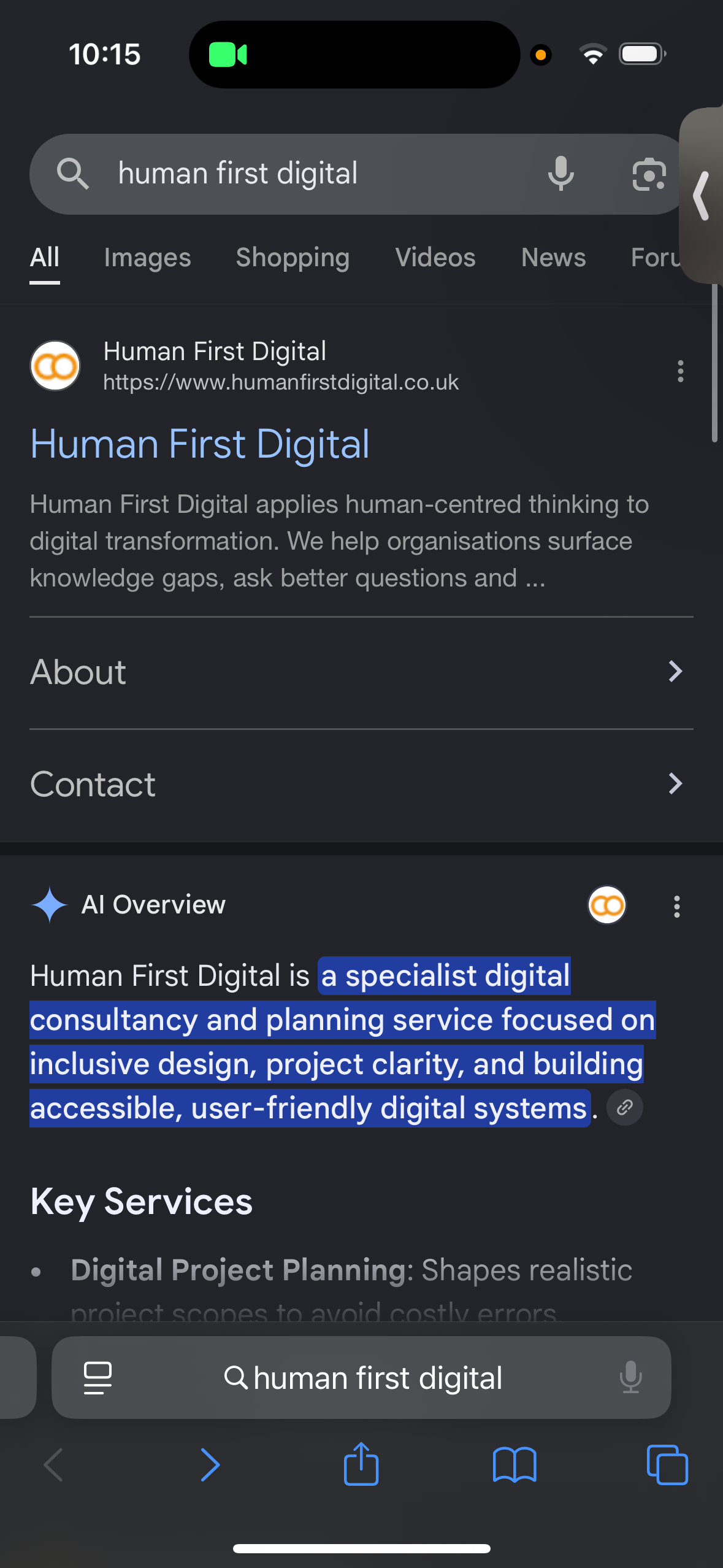
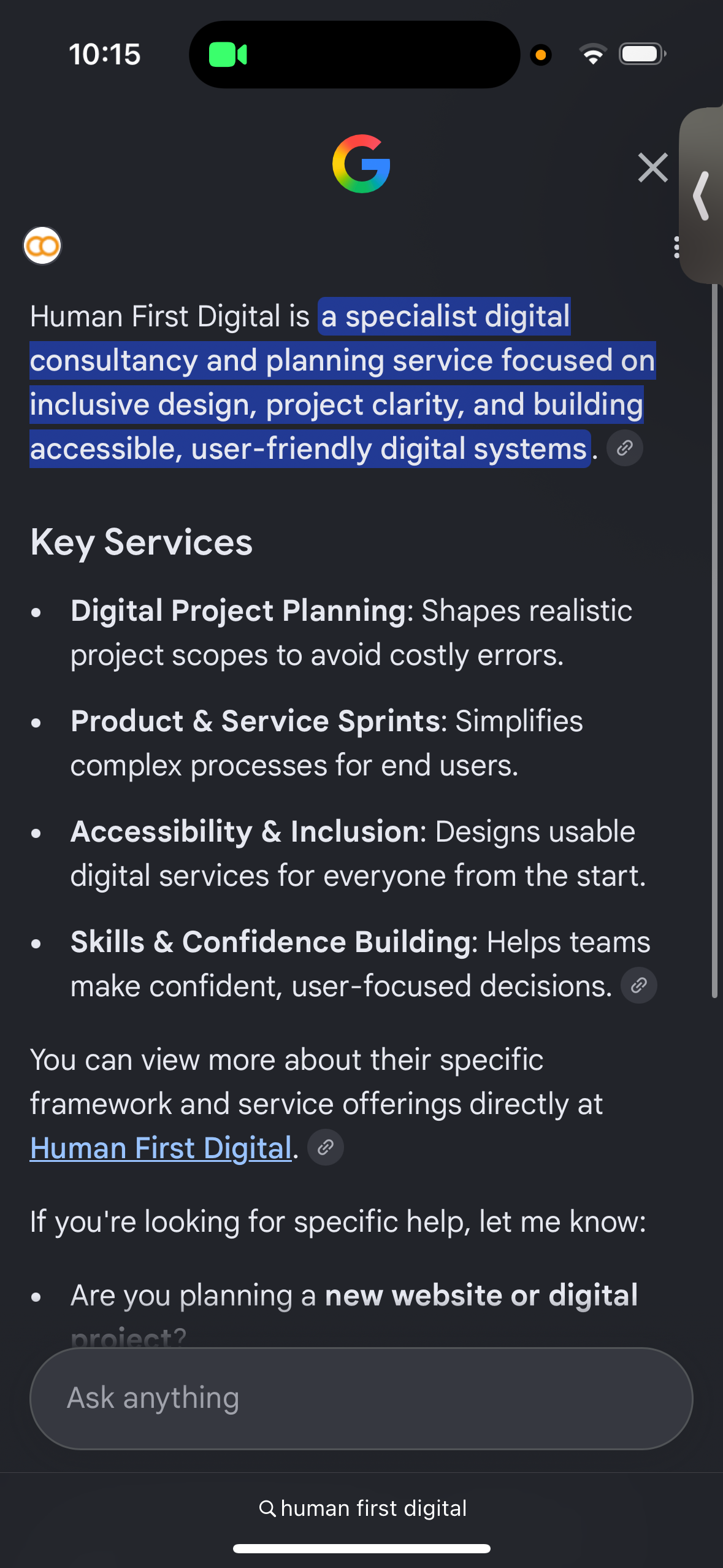
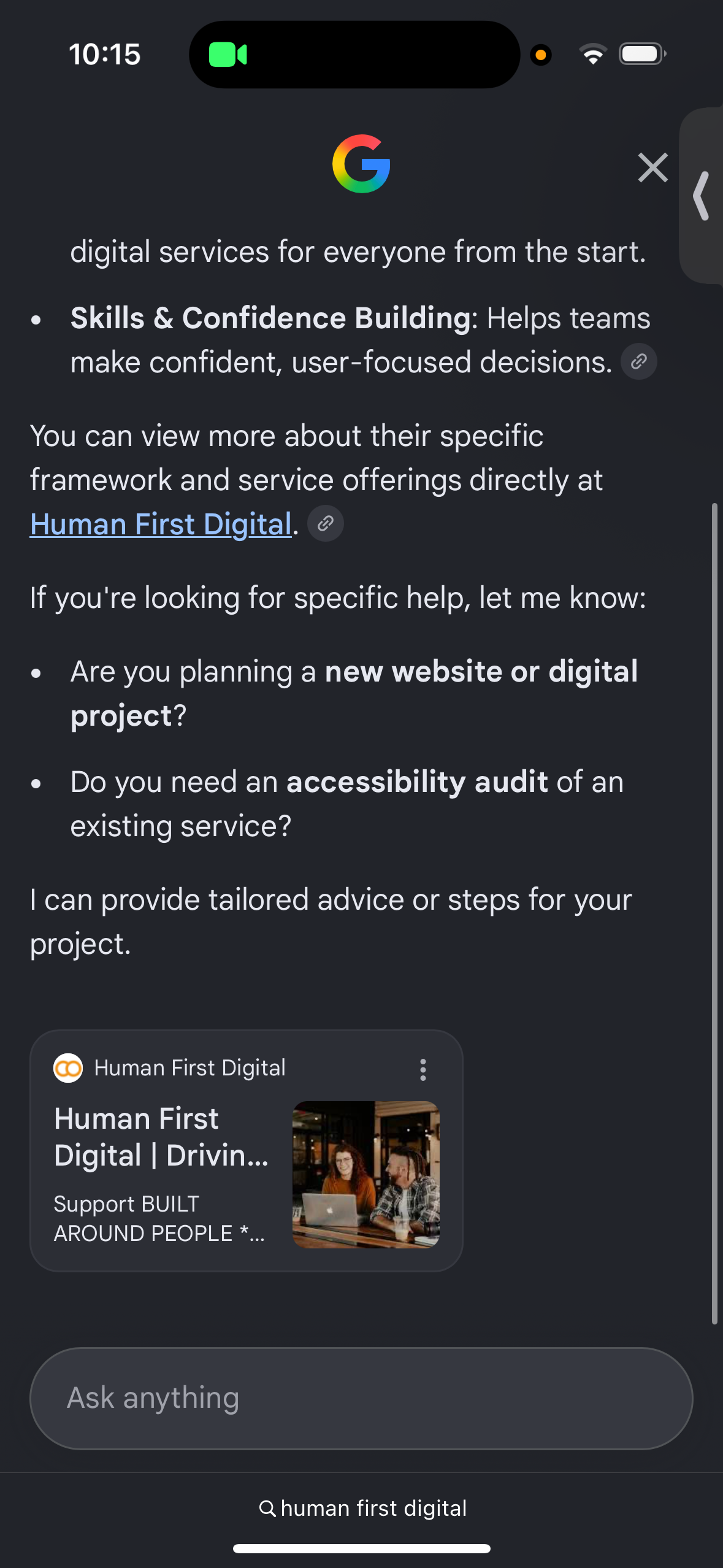
The screenshots accompanying this article came from a Google search conducted independently of me.
Google’s AI Overview has already constructed a reasonably accurate interpretation of Human First Digital.
It has identified the organisation.
It has interpreted several of the services.
It has described what those services achieve.
It has even started translating them into potential customer needs.
That’s encouraging.
But I’m not claiming we’ve “won AEO”.
Far from it.
This was a branded search for Human First Digital. The much more valuable test will be whether the business begins appearing when people ask broader questions without already knowing our name.
Questions such as:
How do I know if my website is fit for AI search?
How can I prepare my business for AI?
Why isn’t my website generating enquiries?
How do I choose the right digital systems for my business?
That’s where this gets commercially interesting.
What have we actually done?
This is perhaps the most interesting part. We haven’t built some enormous specialist AEO infrastructure, we’ve been concentrating on making the business understandable.
Clear service pages.
Useful articles.
Specific questions and answers.
Consistent language.
Logical relationships between subjects.
Original thinking and experience.
Information that explains not just what we do, but why it matters.
And increasingly, more content.
That’s not an AEO trick. It’s good digital publishing.
Google’s current guidance emphasises much the same things: valuable and original content, clear technical structure, crawlability, internal linking, good page experience and important information being available in text.
What about schema, images and all the technical stuff?
They still matter.
Structured data can help search engines understand information and can enable particular search features. It should accurately match the content people can actually see.
Images and video can also provide additional ways for content to be discovered, and Google specifically recommends high-quality visual material where it genuinely adds value.
Technical SEO absolutely hasn’t disappeared.
But none of those things replaces the fundamental requirement:
Create something worth understanding.
That’s the bit I think businesses need to hear.
Early adoption doesn’t mean chasing every new acronym
There’s a huge opportunity in understanding this shift early.
But early adoption doesn’t necessarily mean buying another platform, installing another plugin or commissioning an entirely separate “AEO strategy”.
It might mean:
Getting the fundamentals right before everybody else catches up
Make your organisation understandable
Document what you know
Answer the questions your customers actually ask
Publish useful original information
Build clear relationships between your expertise, people, services and evidence
Make sure search engines can access and understand it
Then measure what happens.
The technology around search will continue changing.
Google will change.
AI models will change.
The terminology will almost certainly change.
But being clear, useful, technically accessible and demonstrably knowledgeable is unlikely to become a disadvantage.
Perhaps that’s the most useful way to think about AEO. It’s not SEO disappearing, it’s search becoming much better at understanding what good SEO should have been helping it understand in the first place and this search for Human First Digital has just given me a rather nice little piece of evidence that it’s already happening. 🙌